Draw a pelican stealing a bicycle from a supermarket. Reply with one complete SVG document only, no prose and no code fences. Use viewBox="0 0 200 150" and a transparent background. Use only these colours for every fill and stroke: #06e0c0 #ffc298 #cd85f9 #f1f2f2.
Finish the dad joke
as received● 1 line · 10 words
Why did the open-weights model cross the road?
To get to the other side of the parameter space.
Finish this dad joke. Reply with the punchline only, on one line, without quotes: Why did the open-weights model cross the road?
Draw ASCII art of a parasailer over the sea. At most 12 lines and 32 columns. Reply with the art only: no code fences, no explanation.
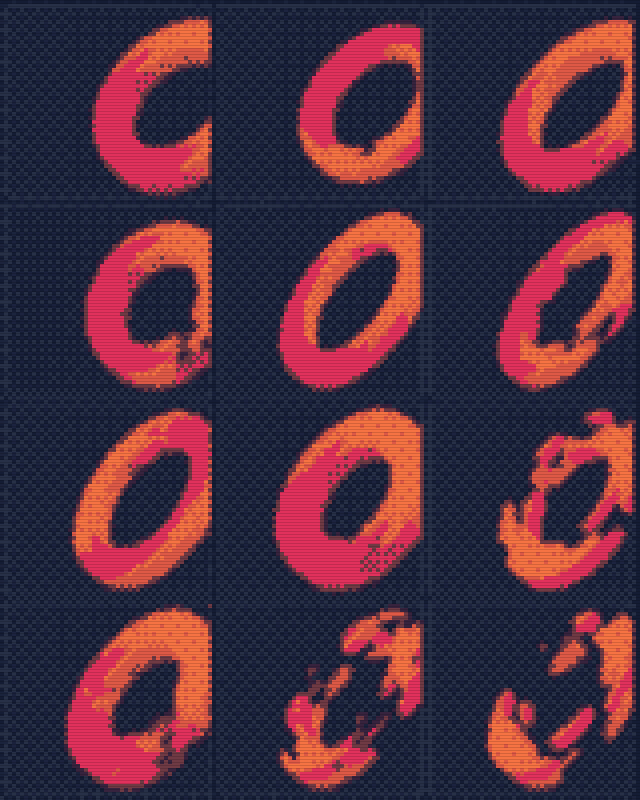
Animate a bouncing ball
as received✕ not JSON
No playable frames in the reply.
Make a 16x16 pixel sprite animation of a ball bouncing, 8 frames. Reply with JSON only, no code fences: {"palette": {"a": "#rrggbb", ...}, "fps": <number>, "frames": [[16 strings of 16 characters], ...]}. At most 4 palette colours with single-letter keys; "." means transparent; exactly 8 frames.
1 of 4 · swipe for more →
The ringer: the same four playful tests for every model, replies shown as received and checked by code. A joke, not a benchmark; never ranked.3 of 4 pass · parasail-gemma-4-26b-a4b-it on parasail · run 2026-10-09 · temperature 0 · cost $0.007 · 2026-10 thing: supermarket · all models →
Worth reading
Picked by rule from 37 tracked pieces: the lab's own post, the most shared, a field report, the latest.
TurboFieldfare enables Gemma 4 26B-A4B inference on Apple Silicon Macs with only 8 GB of RAM by streaming experts from the SSD instead of loading the full model.
The installer never materializes the full source checkpoint and streams required byte ranges directly into the .gturbo layout.
The loopback server has no remote authentication or TLS and the client must authorize and run every tool call.
github.com2026-07-29919 HN pts · 342 comments2.4k words
Live hosted endpoints, cheapest first, USD per million tokens. Ties break on output price, then provider name.
Prices for the same weights vary 7×
14 providers with a live price, from $0.042 to $0.28 per million input tokens; the median is $0.10. One dot per provider, cheapest in teal. 1 free-tier row not drawn.
Hugging Face does not say who downloads a model or with what. These are the proxies: API providers listing it, quantized builds, fine-tunes/adapters/merges, and Spaces that load it.
Widely served (16 API providers); heavily run locally (411 quantized builds); a big base for builders (341 fine-tunes, adapters and merges).
As a service16Cloudflare, CoreWeave, Darkbloom, DeepInfra +12
Weights only, an estimate: leave room for the KV cache. Method
Fits a 16 GB card at INT4
About 16 GB at INT4, 31 GB at FP8, 62 GB at BF16: weights only, so leave room for the KV cache. Every expert must be resident, so total parameters count.
The probe replies as received on 2026-10-07 from parasail, graded by code. Receipts, not a score.
Write a function● pass
def is_balanced(s: str) -> bool:
    stack = []
    mapping = {")": "(", "}": "{", "]": "["}
    for char in s:
        if char in mapping.values():
            stack.append(char)
        elif char in mapping:
            if not stack or stack.pop() != mapping[char]:
                return False
Everything else, folded: the full tables, every source.
Benchmarks
16 rows
Benchmarks 16 rows
measured third-party leaderboard rowauthor-reported number from the model card or eval files (16)No confidence intervals unless the source gave them; settings differ between rows, so compare within a benchmark, not across. Date = the benchmark's own date when it gives one, else when we read it.
Labels are evidence, not verdicts: measured a third-party leaderboard row for this model; author-reported a number the model author published in the card or eval files; structural a deterministic signal from the name, config or chat template, or a decision-model estimate. Each chip links to its source. All use cases.
Weights-only memory for gemma-4-26B-A4B-it: params × bytes/param × 1.2 overhead. KV cache and activations are extra. How this is computed.
BF16 (2 bytes/param)
62 GB · Single high-end GPU (<80 GB)
FP8 (1 byte/param)
31 GB · Single high-end GPU (<80 GB)
INT4 (0.5 bytes/param)
16 GB · Single GPU (<24 GB)
Weights only (params × bytes/param × 1.2 overhead); KV cache and activations extra. MoE: all experts must be resident, so total parameters count.
First look, every probe
6 probes
First look measured
A fixed probe set run against a live API endpoint: the same questions for every model, answers graded by code, nothing judged by a model. Latencies are single-request wall clock from one client location, not a benchmark.
via parasailparasail-gemma-4-26b-a4b-it4/5 probes passfirst visible token 0.9 send-to-end 51 tok/s (median of 3)
Probe
Result
Latency
Reply (truncated)
Self-description
info
2.2 s
I am a large language model, trained by Google. I do not know the specific date of my training data cutoff.
def is_balanced(s: str) -> bool:
stack = []
mapping = {")": "(", "}": "{", "]": "["}
for char in s:
if char in mapping.values():
stack.append(char)
elif char in mapping:
if not stack or stack.pop() != mapping[char]:
return False
Multi-step arithmetic
fail
0.6 s
14
Needle recall at 128k tokens
pass
89.6 s
amber-falcon-7731
Probe set firstlook.v1 · observed 2026-10-07 20:09 UTC · endpoint · provider docs · cost of this run $0.02
All variants
40 variants
Lineage
Fine-tuned from google/gemma-4-26B-A4B (same organization)Family: google/gemma-4752 derivatives on the Hub
Hosted endpoints observed for gemma-4-26B-A4B-it, sorted by input price (USD per million tokens). Each row names its observer and date; prices change daily, so check the source before quoting. Cheapest observed input price: $0.00/M.
Ranked by source signals (HN, Lobsters, authority domains, official posts) and recency. Summaries are generated from a stored copy of the article text; every sentence cites a span of that text, and nothing is shown that failed the citation check.
blog.google2026-06-05officialauthorityHN front pageabout the gemma 4 familyHN 406 pts · 130 comments714 words
Google released new Gemma 4 checkpoints optimized with Quantization-Aware Training to improve efficiency on edge devices and consumer GPUs. The E2B model achieves a 1GB memory footprint using a mobile-specialized schema that applies targeted 2-bit quantization to token generation layers. Developers can access GGUF formats ready for llama.cpp and MTP QAT checkpoints to preserve inference speedups while running locally.written, reviewed, cited
The mobile-specialized schema pre-calculates activation scaling settings during training to reduce workload on mobile chips.
Targeted 2-bit quantization compresses token generation parts while keeping core reasoning layers at higher precision.
Deploying only needed modalities allows the Gemma 4 E2B text-only model to require less than 1 GB of memory.
blog.google2026-05-05officialauthorityHN front pageabout the gemma 4 familyHN 687 pts · 330 comments796 words
Google released Multi-Token Prediction (MTP) drafters for the Gemma 4 family under the same open-source Apache 2.0 license as Gemma 4. These drafters deliver up to a 3x speedup for models like the 26B MoE and 31B Dense versions without quality degradation. Benchmarks on hardware such as the NVIDIA RTX PRO 6000 show that increasing batch sizes to 4 to 8 unlocks up to a ~2.2x speedup locally.written, reviewed, cited
The MTP drafter shares the target model's KV cache to avoid recalculating context the larger model has already processed.
For E2B and E4B edge models, an efficient clustering technique in the embedder accelerates generation where logit calculation is a bottleneck.
The 26B mixture-of-experts model presents unique routing challenges at a batch size of 1 on Apple Silicon.
github.com2026-07-29authorityHN front pageHN 919 pts · 342 comments2,408 words
TurboFieldfare enables Gemma 4 26B-A4B inference on Apple Silicon Macs with only 8 GB of RAM by streaming experts from the SSD instead of loading the full model. The runtime maintains ~2 GB of weights and a 4K KV cache in memory, achieving 5.1-6.3 tok/s on an 8 GB M2 MacBook Air and 31-35 tok/s on a 24 GB M5 Pro. The complete installation occupies about 14.3 GB for the text model plus optional image packs.written, reviewed, cited
The installer never materializes the full source checkpoint and streams required byte ranges directly into the .gturbo layout.
The loopback server has no remote authentication or TLS and the client must authorize and run every tool call.
The image tower requires an M2 or newer Apple Silicon Mac while text-only inference remains available on M1.
neomindlabs.com2026-07-15HN front pageHN 329 pts · 212 comments1,937 words
Engineers can run Google's Gemma 4 26B-A4B model on a 13-year-old dual Xeon E5-2690 v2 server without a GPU by using the ik_llama.cpp fork with GGML_USE_IQK_MULMAT disabled. The system achieves approximately 5.2 tokens per second for decoding and 16 tokens per second for prompt evaluation when quantized to Q8_0. This repurposed HP StoreVirtual box costs under $300 and operates using only AVX1 instruction sets.written, reviewed, cited
The graph builder emits MOE_FUSED_UP_GATE and FUSED_UP_GATE ops unconditionally even when AVX2 instructions are unavailable.
Disabling --run-time-repack is mandatory because it reorders weights into an AVX2-only layout that garbles output on AVX1 hardware.
The fix splits combined up_gate_exps tensors into two separate slices to run distinct mul-mat-IDs instead of relying on fused kernels.
github.com2026-07-22authorityHN front pageabout the gemma 4 familyHN 191 pts · 44 comments714 words
Cactus Hybrid introduces on-device models that score every answer with a confidence between 0 and 1 to decide when to hand off to a bigger model. The Gemma 4 E2B Hybrid model matches Gemini 3.1 Flash-Lite performance by routing only 15–55% of queries to the cloud while running the rest locally. It is MIT-licensed and achieves a 0.770 AUROC on MMLU, with a probe trained on zero audio data yet reaching 0.79–0.88 AUROC on four audio benchmarks.written, reviewed, cited
Weights on the meta device crash the confidence read because probes score generations outside the module forward path.
The probe is a patch you compile into the llama.cpp engine rather than a standalone library component.
Transformers version 5.14 and above cause a segfault on this specific checkpoint.
arXiv links found in the model card and its tags. "Peer-reviewed" is shown only with evidence: a published venue in OpenAlex (measured) or the authors' own journal reference on arXiv (reported).