Draw a pelican stealing a bicycle from a supermarket. Reply with one complete SVG document only, no prose and no code fences. Use viewBox="0 0 200 150" and a transparent background. Use only these colours for every fill and stroke: #06e0c0 #ffc298 #cd85f9 #f1f2f2.
Finish the dad joke
low reasoning✕ empty reply
Empty reply.
Finish this dad joke. Reply with the punchline only, on one line, without quotes: Why did the open-weights model cross the road?
A parasailer, in ASCII
low reasoning✕ empty reply
Empty reply.
Draw ASCII art of a parasailer over the sea. At most 12 lines and 32 columns. Reply with the art only: no code fences, no explanation.
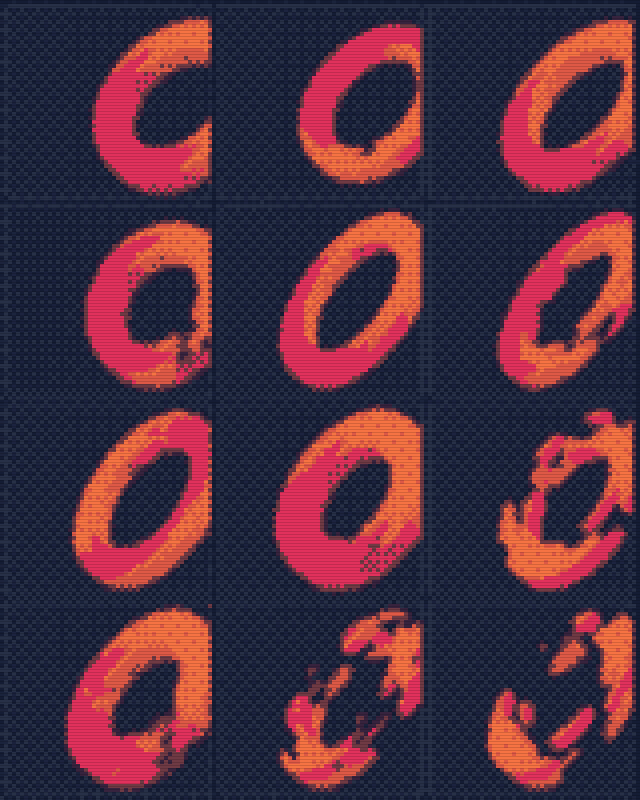
Animate a bouncing ball
low reasoning✕ empty reply
No playable frames in the reply.
Make a 16x16 pixel sprite animation of a ball bouncing, 8 frames. Reply with JSON only, no code fences: {"palette": {"a": "#rrggbb", ...}, "fps": <number>, "frames": [[16 strings of 16 characters], ...]}. At most 4 palette colours with single-letter keys; "." means transparent; exactly 8 frames.
1 of 4 · swipe for more →
The ringer: the same four playful tests for every model, replies shown as received and checked by code. A joke, not a benchmark; never ranked.1 of 4 pass · parasail-qwen35-9b on parasail · run 2026-10-09 · temperature 0 · cost $0.020 · 2026-10 thing: supermarket · all models →
Worth reading
Picked by rule from 35 tracked pieces: the lab's own post, the most shared, a field report, the latest.
llm.vhdl is a full-fabric VHDL inference engine for Qwen3.5-class models on Xilinx XCVU33P and XCVU35P FPGAs using INT4 streaming matvecs and HBM-resident weights.
Reconfiguring the FPGA tears the PCIe bus down and rescans it, which can hang the host if a transaction faults.
The inter-die link for the two-die residual hand-off cannot come up because the carrier's refclk oscillator sites are unpopulated.
github.com2026-10-042 HN pts1.6k wordsabout the Qwen3.5 family family
25 best of 35 tracked
The 3 picks above, plus these 22. Top is the radar's score: discussion, source authority and the lab's own posts, fading with age.
Hugging Face does not say who downloads a model or with what. These are the proxies: API providers listing it, quantized builds, fine-tunes/adapters/merges, and Spaces that load it.
Widely served (7 API providers); heavily run locally (615 quantized builds); a big base for builders (2,164 fine-tunes, adapters and merges).
As a service7Darkbloom, DeepInfra, Featherless, OVHcloud +3
The probe replies as received on 2026-10-07 from parasail, graded by code. Receipts, not a score.
Write a function● pass
def is_balanced(s: str) -> bool:
    stack = []
    mapping = {')': '(', ']': '[', '}': '{'}
    for char in s:
        if char in mapping:
            if not stack or stack[-1] != mapping[char]:
                return False
            stack.pop()
        elif char in '({[':
            stack.appen
Everything else, folded: the full tables, every source.
Benchmarks
9 rows
Benchmarks 9 rows
measured third-party leaderboard rowauthor-reported number from the model card or eval files (9)No confidence intervals unless the source gave them; settings differ between rows, so compare within a benchmark, not across. Date = the benchmark's own date when it gives one, else when we read it.
Generated 2026-10-07 14:59 UTC by parasail-gemma-4-26b-a4b-it; each numeral points at the fact it rests on. Not a verdict.
Use-case evidence
7 use cases
What it is good at 7 use cases
Labels are evidence, not verdicts: measured a third-party leaderboard row for this model; author-reported a number the model author published in the card or eval files; structural a deterministic signal from the name, config or chat template, or a decision-model estimate. Each chip links to its source. All use cases.
Weights-only memory for Qwen3.5-9B: params × bytes/param × 1.2 overhead. KV cache and activations are extra. How this is computed.
BF16 (2 bytes/param)
23 GB · Single GPU (<24 GB)
FP8 (1 byte/param)
12 GB · Single GPU (<24 GB)
INT4 (0.5 bytes/param)
5.8 GB · Single GPU (<24 GB)
Weights only (params × bytes/param × 1.2 overhead); KV cache and activations extra.
First look, every probe
6 probes
First look measured
A fixed probe set run against a live API endpoint: the same questions for every model, answers graded by code, nothing judged by a model. Latencies are single-request wall clock from one client location, not a benchmark.
via parasailparasail-qwen35-9b5/5 probes passfirst token 2.8 s(thinking only within the budget)end-to-end 117 tok/s (median of 3)
def is_balanced(s: str) -> bool:
stack = []
mapping = {')': '(', ']': '[', '}': '{'}
for char in s:
if char in mapping:
if not stack or stack[-1] != mapping[char]:
return False
stack.pop()
elif char in '({[':
stack.appen
Multi-step arithmetic
pass
9.4 s
16
Needle recall at 128k tokens
pass
9.0 s
amber-falcon-7731
Probe set firstlook.v1 · observed 2026-10-07 20:16 UTC · endpoint · provider docs · cost of this run $0.02
All variants
40 variants
Lineage
Fine-tuned from Qwen/Qwen3.5-9B-Base (same organization)Family: Qwen/Qwen3.52,779 derivatives on the Hub
Hosted endpoints observed for Qwen3.5-9B, sorted by input price (USD per million tokens). Each row names its observer and date; prices change daily, so check the source before quoting. Cheapest observed input price: $0.08/M.
Ranked by source signals (HN, Lobsters, authority domains, official posts) and recency. Summaries are generated from a stored copy of the article text; every sentence cites a span of that text, and nothing is shown that failed the citation check.
qwen.ai2026-02-16officialauthorityHN front pageabout the Qwen3.5 familyHN 434 pts · 214 comments17,678 words
Qwen3.5-397B-A17B is the first open-weight native vision-language model in the Qwen3.5 series, released on 2026/02/15. Built on a hybrid architecture fusing linear attention via Gated Delta Networks with a sparse mixture-of-experts, it activates just 17 billion parameters per forward pass despite comprising 397 billion total parameters. The model expanded language support from 119 to 201 languages while matching the >1T-parameter Qwen3-Max-Base capability.written, reviewed, cited
The hosted Qwen3.5-Plus model defaults to a 1M context window and includes official built-in tools with adaptive tool use.
For the BrowseComp benchmark, the model achieved a score of 69.0 using simple context-folding, while the discard-all strategy reached 78.6.
unsloth.ai2026-03-04authorityHN front pageabout the Qwen3.5 familyHN 416 pts · 107 comments729 words
Engineers can fine-tune the Qwen3.5 model family (0.8B, 2B, 4B, 9B, 27B, 35B-A3B, 122B-A10B) with Unsloth, which trains models 1.5 times faster using 50% less VRAM than FA2 setups. VRAM requirements for bf16 LoRA range from 3GB for the 0.8B model to 56GB for the 27B model, while the 35B-A3B variant operates on 74GB VRAM and the 122B-A10B on 256GB VRAM. MoE fine-tuning leverages a recent update delivering over 35% less VRAM usage and approximately 6x longer context support.written, reviewed, cited
To preserve reasoning ability, mix reasoning-style examples with direct answers while keeping a minimum of 75% reasoning.
Router-layer fine-tuning is disabled by default for stability on MoE models like Qwen3.5‑35B‑A3B.
You can run Qwen3.5 RL with Unsloth even though it is not supported by vLLM by setting fast_inference=False.
github.com2026-09-21authorityHN front pageabout the Qwen3.5 familyHN 463 pts · 210 comments6,746 words
Kev is a family of small decision models built on Qwen3.5 and Qwen3.8 that you can train and run locally. The API matches TypeSafe's System One, so you can point their Python SDK at your local server. Models use a small adapter on a frozen base, except Kev-27B which ships as 51 GB of full weights. The 27B model achieves 0.851 accuracy on new sources.written, reviewed, cited
The Kev-27B model requires 96–128 GB of RAM on Macs, a requirement marked as expected but not measured.
An explicitly requested accelerator fails instead of falling back if the probe times out or crashes.
github.com2026-10-04authorityabout the Qwen3.5 familyHN 2 pts · 0 comments1,558 words
llm.vhdl is a full-fabric VHDL inference engine for Qwen3.5-class models on Xilinx XCVU33P and XCVU35P FPGAs using INT4 streaming matvecs and HBM-resident weights. It supports single-card 9B or two-card 27B configurations, achieving about 2.5 tokens/s on silicon at 75 MHz. The 27B target fits a VU35P at about 46% LUT but requires the Jungle Cat board, which lacks PCIe and relies on slow Ethernet or JTAG for weight loading.written, reviewed, cited
Reconfiguring the FPGA tears the PCIe bus down and rescans it, which can hang the host if a transaction faults.
The inter-die link for the two-die residual hand-off cannot come up because the carrier's refclk oscillator sites are unpopulated.
The Jungle Cat board lacks PCIe, forcing weight loading over a CoE/JTAG bridge that operates at roughly 1 MB/s.
news.ycombinator.com2026-08-06about the Qwen3.5 familyHN 4 pts · 2 comments157 words
This American (San Francisco) model, Laguna S 2.1:118B-a9B, outperforms Qwen3.5:122B-a10B and Sonnet in current benchmarking tests. It demonstrates better personality and natural creativity when designing UIs. Benchmarks need to include a minimum of hardware requirements, which are currently missing.written, reviewed, cited
All coverage tracked for this model (35) — append-only, nothing is ever removed